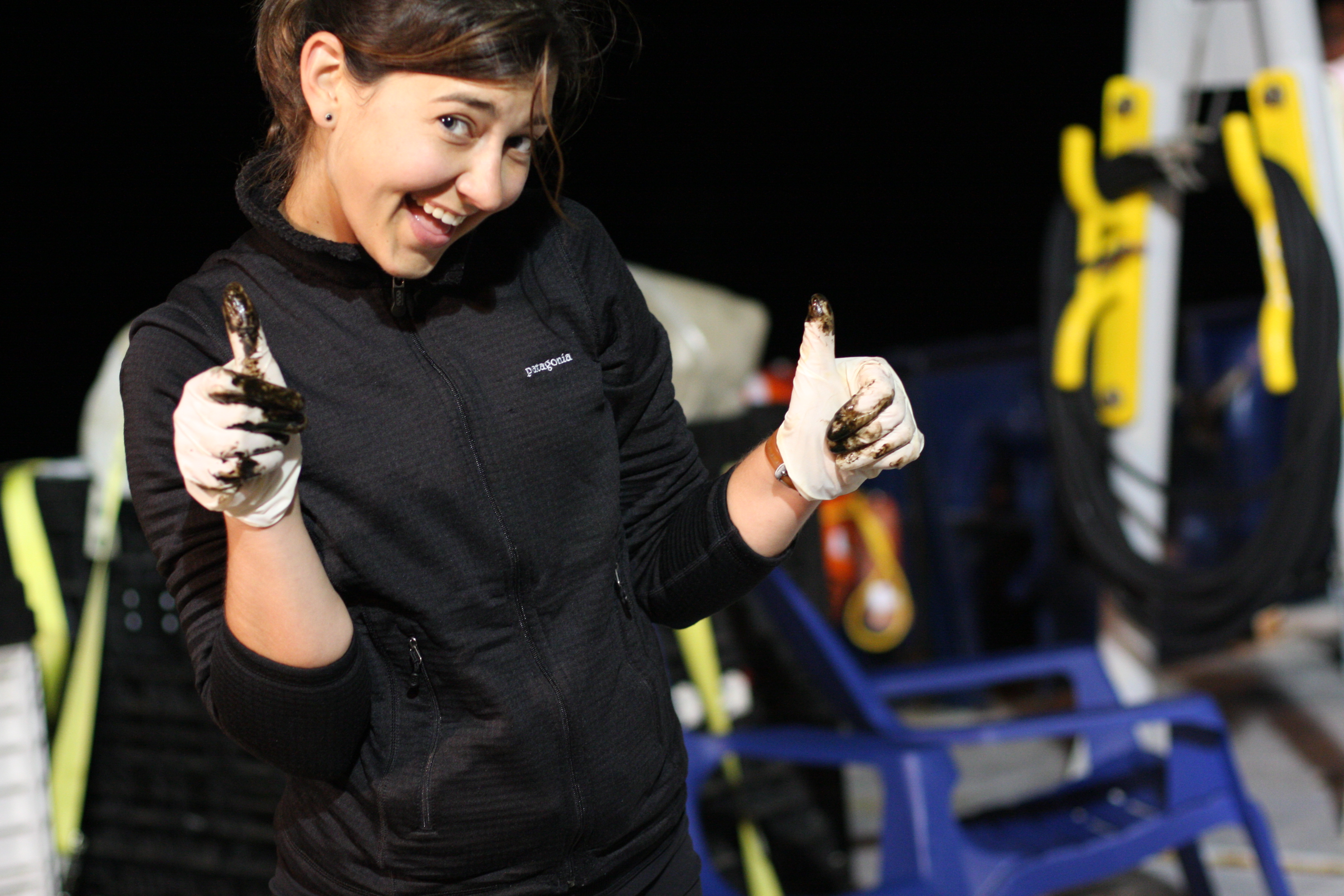
Patience and the money shot

A blog post I wrote for the MBARI Midwater Ecology Expedition March 22-28, 2013 logbook

If you follow MBARI expedition blogs (and you should!), you’ve surely read a lot about deep-sea species. But how do we define a species? And how can we tell which individuals belong to a given species? Those may seem like simple questions, but in fact, sometimes they are not. Scientists generally think of a species as being composed of those individuals that are able to successfully reproduce with each other. However, scientists clearly cannot observe each animal to determine which other animals it is mating with. So instead, we group individuals that have the same morphological appearance together as a species. For example, black versus red coloration. Big eyes versus little eyes. Ten teeth versus eight teeth. This method of categorization works for the majority of cases…

However, there are some instances where animals that have the same appearance, and are therefore considered to be the same species, have actually been found to be separate species based upon significant differences in their DNA. These unknown species are termed "cryptic species" because they were "hidden" until their DNA was sequenced. But, how can this be? How can two individuals that look exactly alike be different? The answer is that they can have differences in behavior, physiology, or ecology, all of which can’t be determined from what the animal looks like.

So I am looking for cryptic species among the Pteropoda, which are snails that grow up to about 2.5 centimeters (1 inch) (but are usually smaller) and live their entire lives in the water column. They have a reduced or absent shell and a foot modified into wings for swimming (pteropods means "wing-foot"). These midwater organisms are important as food for many fish, cephalopods, and even marine mammals. They are potential indicators of global climate change as the composition of their shells makes them especially vulnerable to disintegration as the oceans become more acidic. However, there is a lot of disagreement regarding how many species of pteropods there are and which individuals belong to each species. For these reasons, I am collecting specimens via SCUBA, ROV dive, and trawl nets from broad geographical locations, and sequencing some of their DNA to determine the number of pteropod species and find out whether, for instance, individuals collected in Hawaii are from the same species as those that look exactly the same collected off of California.

Screen Shot 2013-05-08 at 1.23.49 PM


Before taking a piece of tissue for DNA sequencing, however, I have to get a good picture of each individual. This is very important because I may find new species among my samples and need to have detailed images of what they look like—I’m going to have to describe the mouth-parts of animals the size of my pinky nail after all! The process is not as simple as taking one or two snap-shots and moving on to the next task. Most of the pteropods are less than a centimeter (half an inch) in length, so the first step is to have a good macro lens on the camera. But the closer you are, the more any movement is magnified, so the camera needs to be attached to a stand to stabilize it. Then there is the requirement of having the animal in a tank of seawater. Correction: a
sloshing tank of seawater due to the constant movement of the ship. And then there is the animal that, not used to being in the limelight, desires escape from the whole scene and constantly swims to the edges of the tank, where it is impossible to get a nice picture. So you gently prod the animal to the center of the tank and get the composition you want, but in the half second it takes to press the shutter button the animal has shifted a fraction of an inch and is therefore out of the shot. Imagine taking a close-up shot of a flower in bloom. And then imagine that it’s windy. And that your dog is pulling the leash that you're holding. Getting a good picture of a pteropod is somewhat like that. So you often spend one or two hours, taking 50 to 150 shots, and you might get one or two decent images. But it’s a necessary part of the science I’m performing. And the money shot is so worth it.

Biodiversity in the deep sea

On a recent research cruise, led by Dr. Mike Vecchione, to the Bear Seamount in the North West Atlantic we found numerous species of midwater animals including...

Lampadioteuthis megaleia

This species has 23 large photophores!!!
You can see some of these as round white structures around the eyes

Screen Shot 2013-05-08 at 1.36.01 PM

Ship-mate Michelle Staudinger wrote an article about the cruise for Deep Sea News (incl. pictures)

NOAA article on the cruise (incl. pictures)

The deep-sea arm-dropping squid

“Economy of autotomy in the mesopelagic squid Octopoteuthis deletron”

published in

Marine Ecology Progress Series


lonely_arm


Link to the article and video:
http://www.int-res.com/abstracts/meps/v458/p133-140/

Screen Shot 2013-05-08 at 1.30.26 PM
http://www.youtube.com/watch?v=ylAlHoS6wzo

Numerous online news sites picked the story up:

Science NOW
Discover Magazine
Smithsonian.com

Pack it up for the field

The ONR MURI group traveled to the Carribbean island of Curacao to study polarzation camouflage in fish and squid.

IMG_2577